








Contemporary houses of worship are leaders in audiovisual production. Worship leaders have long been early adopters of new music and audio gear, and the move from amplified stages to silent stages is the latest example.
Lowering stage volume is a service to everyone — the FOH engineer working on the mix, the musicians who can hear themselves clearly, the congregation in the front rows, and the livestream viewer at home. The trick is doing it without losing the energy of a live performance.
This article covers what a silent stage is, who benefits, what gear you need, and the practical setup options for every musician on stage.
What is a silent stage?
On a silent stage, musicians work with the production staff to play at the lowest stage volume possible. Silent stages use direct-in (DI) signals for instruments to reduce the number of open microphones on stage, creating the cleanest possible signal path for the FOH engineer to build a clear, punchy mix.
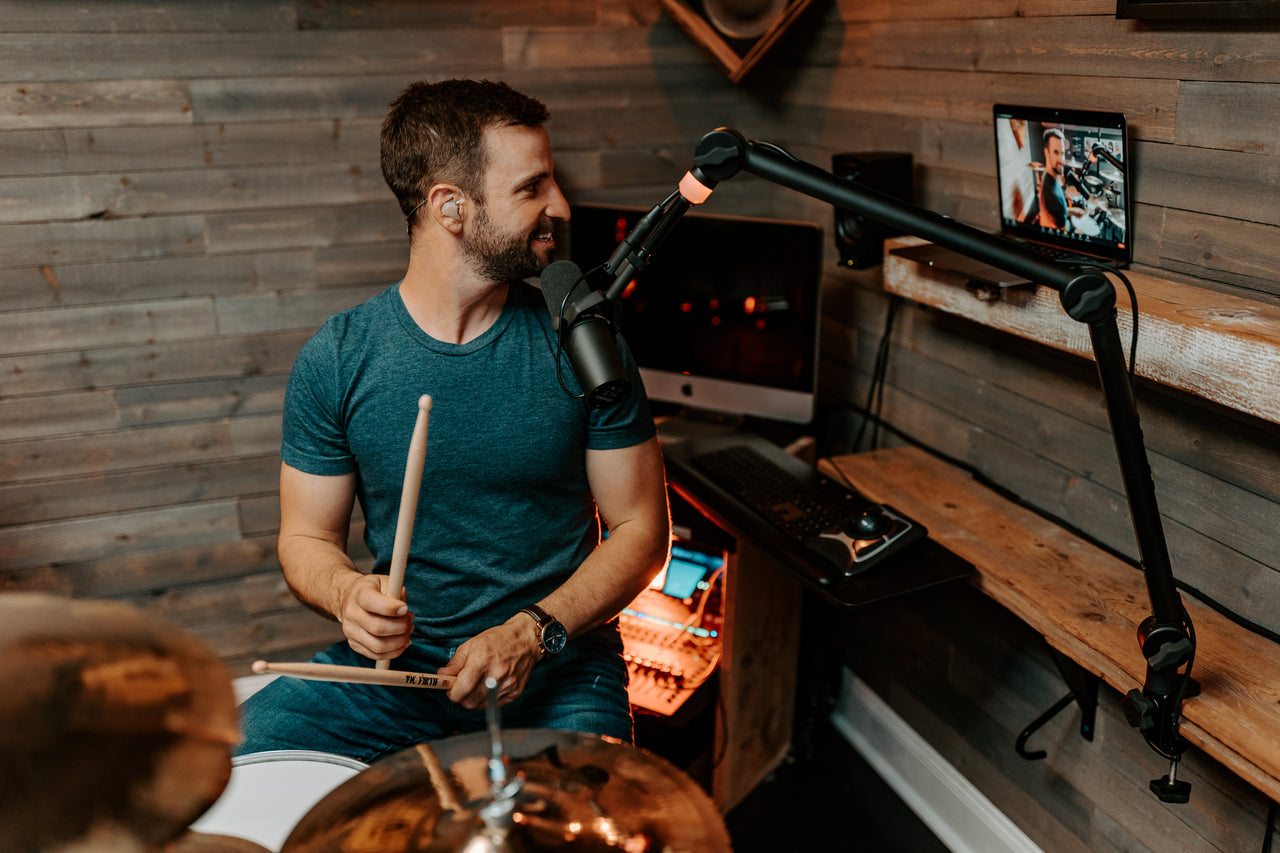
Instead of playing through amplifiers, guitarists, bassists, and keyboardists go direct and listen to their own mix through wireless in-ear monitors. Drummers — also using in-ear monitors — set up behind an iso shield, play with brushes or lighter sticks, or switch to an electronic kit to bring stage volume down further.
A silent stage still creates a real concert experience for the congregation. The difference is that the energy comes through the PA at a controlled volume, not from open amps and drums fighting each other on stage.
Setting up a silent stage takes coordination between musicians, the FOH engineer, the monitor mixer, and the worship leader. The payoff is worth the work.
Benefits of a silent stage in worship
A silent stage helps everyone in the room — and everyone watching at home.
For FOH engineers
FOH engineers prefer silent stages because they create the ideal conditions for live mixing. With fewer open microphones on stage, the signal-to-noise ratio improves dramatically. There’s less bleed from amplifiers and drums into vocal microphones, and less risk of feedback. The engineer gets near-studio-level control over each instrument and vocal.
The cleaner mix also makes special effects — stereo shimmer reverb on a guitar, ping-pong delays on a lead vocal — land the way they’re meant to. Open stage bleed muddies those effects on traditional stages.
For musicians on stage
With in-ear monitors, every musician hears a consistent personal mix anywhere on stage. No more relying on floor wedges that only sound right in the sweet spot. With personal monitor mixing apps that come with most modern digital mixers, players can adjust their own mix in real time without flagging the engineer or affecting what anyone else hears.
There’s also no more hauling heavy combo amps or speaker cabinets to the venue. The whole rig fits in a guitar case and a backpack.
For the congregation
Lower stage volume means the congregation hears the actual FOH mix — not a blend of FOH and stage spill. Front-row seats stop being a hearing risk. Worshippers can sing along without straining over the band.
For livestream viewers
Livestream audio improves when the stage is quieter. Fewer microphones mean less bleed and a cleaner broadcast feed. The visual is also cleaner — fewer cables, no amp stacks, more space for cameras and lighting.
Gear you need for a silent stage
If your worship team is already running services with live music, you probably have some of what you need. Here’s the full list.
In-ear monitors
In-ear monitors are essential. Each musician wears a wireless earpiece on stage to listen to their own personal mix, independent of what other musicians and the audience hear.
Custom-fit IEMs like UE Pro in-ear monitors deliver -26 dB of passive noise isolation, helping musicians protect their hearing across long careers in worship music. The custom mold also keeps the IEM secure during movement on stage.
Wireless receivers and transmitters
Each musician’s mix outputs from the mixer to a wireless transmitter, which sends an RF signal to a belt-worn receiver. The receiver connects to the in-ear monitors via a thin cable. For a complete gear walkthrough including how to spec a wireless system, see How to Mix In-Ear Monitors Without a Dedicated Tour Engineer.
Digital mixer
Digital mixers are central to silent stage operation. They store settings in preset scenes — useful for worship teams that play different setlists week to week. They also support Wi-Fi connections to personal monitor mixing apps. PreSonus, Midas, Allen & Heath, Yamaha, Waves, Mackie, and Behringer all offer companion apps that let musicians adjust their own monitor mixes from a phone or tablet.
Wireless router
Where there’s Wi-Fi, there’s a router. A dedicated wireless router lets musicians control digital mixer functions from iPad, iPhone, or Android devices. If you’re also livestreaming the service, run the livestream feed over Ethernet whenever possible — livestreams take significant bandwidth, and freeing up the Wi-Fi keeps the monitor apps responsive.
Basic acoustic treatment
Room acoustics still matter on a silent stage. You don’t need to spend a fortune on foam panels. Most acoustic issues come from reflective surfaces causing distracting echoes, and parallel surfaces affecting bass response. If the room is too bright or has too many echoes, hang a heavy curtain behind the stage or along any long reflective wall. To control bass, install a corner bass trap to absorb excess low frequencies. To reduce unwanted reflections, avoid placing speakers in corners or within two to three feet of walls.
Silent stage options for guitarists, bassists, and keyboardists
Guitarists, bassists, and keyboardists can’t run their normal amps on a silent stage. They need a way to go direct that still sounds right. A few options:
- Amp modeling — Amp modelers like the Fractal AxeFX, Kemper Profiler, Line 6 Helix, and NeuralDSP Quad Cortex provide component-level modeling of popular guitar and bass amps, speaker cabinets, microphones, and effects. Stereo XLR outputs feed straight to the board.
- Pedalboard amps — Builders like Strymon, Milkman, and Orange make portable amps with speaker-simulated outputs designed for silent stage use.
- Guitar load box — A load box replaces a speaker cabinet, allowing silent operation of a tube or solid-state amp. Useful for guitarists who want the feel of cranking a tube amp without the volume. Two Notes, Universal Audio, and others make load boxes with DI outputs.
- Isolation room — An older approach: keep the amp in an isolated room off-stage and mic it. Requires long cable runs and makes mid-set adjustments difficult, but works for guitarists who can’t live without their physical amp.
- Acoustic guitars — Acoustic guitars can be miked normally or run direct through an amp modeler, a DI box, or an acoustic preamp.
- Keyboards — Most modern keyboards have stereo outputs via quarter-inch or XLR. Quarter-inch outputs benefit from a DI box.
Silent stage options for drummers
Drums are the biggest stage-volume challenge in a silent stage setup. A few approaches that work for worship drummers:
- Acoustic kit with drum shields — The simplest solution. Acrylic shields around the kit prevent bleed into other microphones while letting the drummer play with normal feel and dynamics.
- Brushes or lighter sticks — Brushes or rod-style sticks bring stage volume down significantly. Some drummers need rehearsal time to adjust to the different feel.
- Quieter drumheads and cymbals — Heads and cymbals made for low-volume playing — like Remo Silentstroke heads and Zildjian L80 cymbals — work well for drummers with heavier hands.
- Electronic drums — Electronic kits replace acoustic drums with velocity-sensitive pads triggering high-quality samples. Higher-end kits provide individual outputs for each piece, giving the FOH engineer the same control as a miked acoustic kit.
How a silent stage helps vocalists
Vocals stay miked on a silent stage — singers can’t go direct the way instruments can. But the lower overall stage volume creates real advantages for vocalists.
With in-ear monitors, available in custom and universal fit, singers hear themselves at studio-like detail. That helps reduce vocal strain, improves pitch, and makes it easier to perform with confidence. Singers who can hear themselves clearly don’t push their voice to compensate.
Vocals also sound better on a silent stage because there’s no loud instrument bleed in the mic. The FOH engineer can apply compression, EQ, and effects without compromise.
Good microphone technique still matters. A few basics:
- Sing into the center of the grille. Microphones are less accurate off-axis.
- Avoid bass rumble from proximity effect by holding the mic three to four inches from the face.
- Hold the mic by the body, not the grille. Cupping a cardioid microphone increases the risk of feedback.
- Don’t point the mic at speakers. Use caution holding a mic near the mains.
Frequently asked questions
What is a silent stage in a worship setting?
A silent stage is a worship music setup where instruments run direct (DI) instead of through stage amplifiers, drums use shields or electronic kits to lower volume, and musicians monitor through in-ear monitors instead of floor wedges. The result is a much quieter stage that gives the FOH engineer better control of the mix and creates a better audio experience for the congregation and livestream viewers.
What gear do you need for a silent stage?
You need in-ear monitors for each musician, wireless transmitters and receivers for the IEMs, a digital mixer (ideally with a companion app for personal monitor mixing), a wireless router, and the right direct-input setup for each instrument — amp modelers or pedalboard amps for guitarists and bassists, drum shields or an electronic kit for drummers, and basic acoustic treatment for the room.
Do drummers need electronic drums for a silent stage?
Not necessarily. Many worship drummers use an acoustic kit behind a drum shield, switch to brushes or rod-style sticks, or use low-volume drumheads and cymbals to bring their stage volume down. Electronic kits offer the most control over volume and routing, but they’re one option among several.
How do guitarists and bassists work on a silent stage?
Guitarists and bassists go direct instead of using stage amplifiers. Amp modelers (Fractal, Kemper, Line 6 Helix, NeuralDSP Quad Cortex), pedalboard amps with speaker-simulated outputs, or guitar load boxes that replace a physical speaker cabinet all let players get amp-like tone while sending a clean signal to the board.
How does a silent stage help vocalists in worship?
Vocalists wear in-ear monitors to hear themselves at studio-like detail, which reduces vocal strain, improves pitch control, and helps performers sing with confidence. The lower stage volume also means less instrument bleed into vocal microphones, giving the FOH engineer more room to apply compression, EQ, and effects to make vocals sound their best.
Build a silent stage that serves your worship team
UE Pro custom in-ear monitors are built for worship musicians putting in long hours on stage week after week. Explore the UE Pro custom in-ear monitor lineup — entry-level customs through the flagship — to find the right fit for every role on your worship team.