






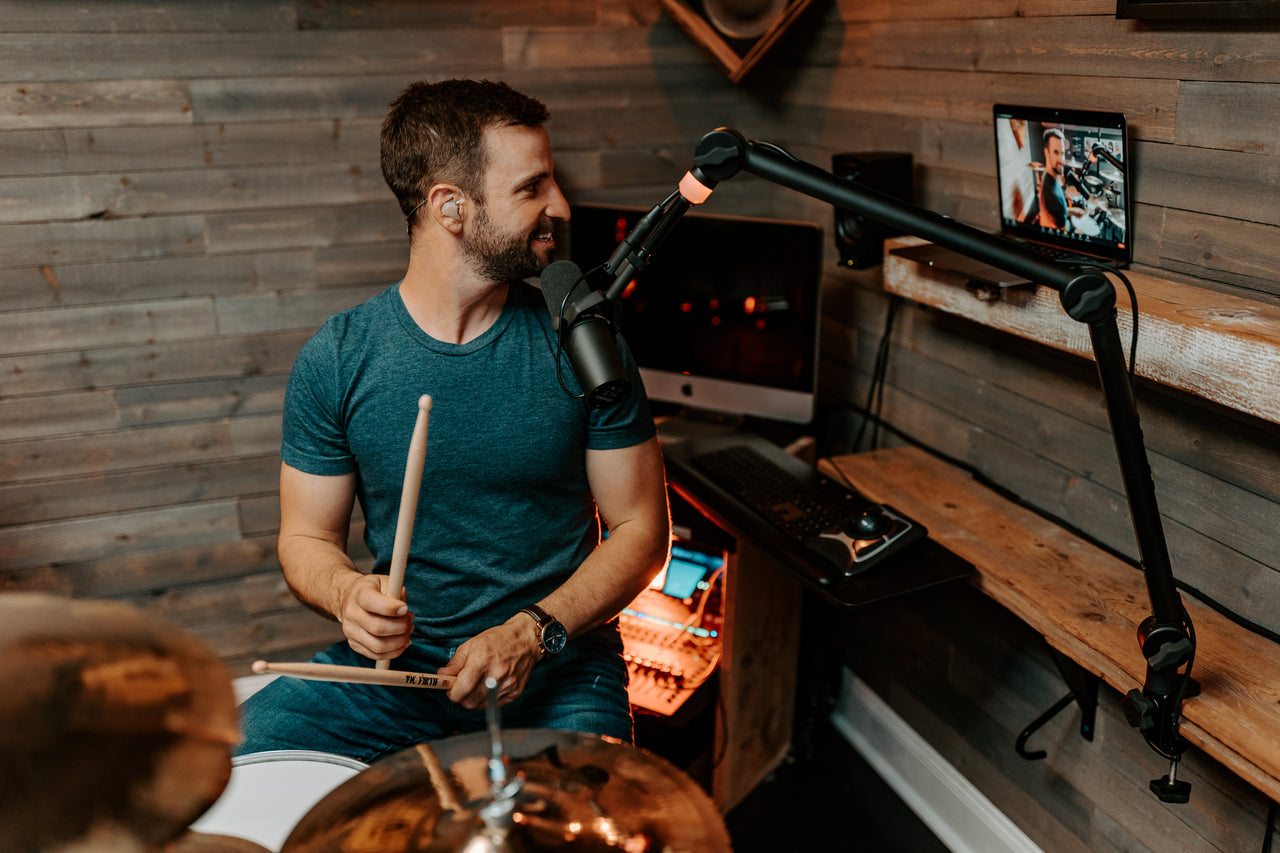




How in-ear monitors help working engineers dial in mixes that translate — from the home studio to the dub stage — with insights from award-winning re-recording mixer Frank Morrone.
We recently sat down with award-winning re-recording mixer Frank Morrone during a NAMM Believe in Music interview to talk about how mixing and mastering with in-ear monitors can sharpen your work. Morrone has worked extensively in film and television, earning multiple awards and nominations for sound mixing on projects including Lost, The Kennedys, and When We Were Kings. What follows are the highlights from that conversation, including why Morrone brings his UE IEMs to every session.
Professional sound quality
“A really accurate monitoring system is one of the most important things for any mixer,” Morrone says. You need to hear every detail of your mix — whether you’re working on music, dialogue, or sound effects — and you need that detail to translate to every other playback system.
Ultimate Ears in-ear monitors deliver clear, detailed sound across the frequency spectrum using multiple balanced armature drivers, each tuned to a specific frequency range to produce a neutral response. That’s different from the single dynamic drivers in most consumer headphones and earphones, which color the response in ways that work for casual listening but obscure the detail mixing engineers need.
Across the UE Pro lineup, the studio reference end is anchored by UE Reference Remastered — the model Morrone uses, engineered for a flat frequency response and studio reference work. (UE RR+ Pro is the current successor model in the lineup, built on the same reference-grade design principles for today’s studio engineers.)
“The Reference Remastered in-ear monitors are especially helpful when I’m replacing dialogue lines with ADR. It’s really important that the mix translates, and Ultimate Ears does that. I get absolutely no surprises. The balance is always great.”
“I also mix a lot of music at home, and Ultimate Ears is great for that as well. I can listen to a mix on my mains, bring it to the Auratones, even bounce an MP3 and listen to it in my car through a Bluetooth connection, and it always translates.”
“If you can get your mix right on the Reference Remastered in-ear monitors, it will translate to any system. They’re very accurate throughout the entire frequency spectrum, all the way across. They don’t hype the bottom or the top.”

Superior isolation
Mixers need a quiet space to work in, and that’s not always possible. Whether you’re sharing a home studio with family or roommates, or you’re on a busy sound stage with a full team, the work demands isolation.
UE Pro custom in-ear monitors deliver approximately −26 dB of passive noise isolation, blocking outside noise in any environment. The deep isolation also helps you protect your hearing — you can monitor at lower volumes without losing detail, which means longer mixing sessions without ear fatigue and less cumulative exposure across a career.
IEMs are particularly useful in small, untreated rooms. Studio monitors project sound that reflects off untreated surfaces, coloring the response in ways that compromise mix decisions. With IEMs, the drivers sit so close to your eardrums that there’s no room interaction at all. You’re hearing the mix without the room in the way.
And because you can work at any time of day without disturbing anyone nearby, the practical constraints on when you can mix relax considerably — or, as Morrone notes, you can work simultaneously with a studio partner.
“When we’re in the studio, the only way to get things done in time is for my mixing partner and I to work on different sections of the mix simultaneously. I’ll work on dialogue and music for the next scene while he’s doing sound effects on the speakers — everything from tires squealing to gunshots.”
“We typically monitor at sound levels between 82 and 95 dB SPL on the monitors, so I need something where I can still hear what I’m doing. The Reference Remastered in-ear monitors are fantastic for two reasons: they totally isolate me from the sound blasting out of the speakers, and I can still hear every detail in the mix.”
“I need something that’s referenced so there won’t be any surprises when I listen back on the main monitors. The Reference Remastered in-ear monitors are perfect for that because I’m doing a lot of crucial mixing in them. Between dialogue, music, ADR, and groups, those balances are really delicate.”
Hearing every detail
Isolation isn’t only about protecting your ears — it’s what lets you hear the critical details in the first place. Whether you’re dialing in mic placement, shaping the decay of a reverb tail, or balancing background dialogue against music, IEMs let you zoom in on the mix in a way speakers can’t match.
Reference IEMs like the model Morrone uses are engineered for a balanced response across lows, mids, and highs, which is what makes them reliable for translation across different playback systems — from a car stereo to a cinema sound system.
“For me, in-ear monitors provide an intimacy with the sound that you just don’t get with near field monitors because of the space around you. Physics come into play and change the sound depending on how far apart they are and your left and right separation.”
“A lot of times, when I’m listening on monitors, I’ll hear a low-end rumble in the background from a truck going by or something — especially if I have a mic open and I’m doing an overdub. One drawback is that you can’t record while using nearfield monitors, which I can while using in-ears.”
“Whether I’m working on dialogue for a film in Dolby Atmos or mixing music in stereo, I get an idea of what the balance is going to be by listening on in-ears. Then, when I listen back on the main monitors, I make decisions about where I’ll place each instrument. The in-ears give me a really good starting point for balance.”
Want to learn more about mixing with IEMs from the ground up? See Why You Should Mix With In-Ear Monitors for the awareness-level case. For high-resolution listening to Spatial Audio and Dolby Atmos productions specifically, see Spatial Audio for Music Producers and Engineers.
Frequently asked questions
Can in-ear monitors replace studio monitors for mixing?
In most professional workflows, IEMs complement studio monitors rather than replace them. Monitors give you the air-moving experience that approximates how listeners will hear music in real environments; IEMs give you precision, detail, and isolation. Engineers like Morrone use both deliberately — IEMs to dial in balance and catch detail, monitors to make placement and reverb decisions in a room context. The combination is more reliable than either alone.
What makes UE Pro IEMs accurate for mixing?
Two technical elements. First, multiple balanced armature drivers tuned to specific frequency ranges produce a flatter response than the single dynamic drivers in most consumer headphones. Second, the custom-fit design seals against the ear canal, blocking outside noise and eliminating bleed from your environment. Together, those mean what you hear is closer to what’s actually in the mix — not influenced by your room, your fit, or external noise. The UE RR+ Pro model is the studio-reference custom in the current lineup, designed specifically for this kind of work.
How loud should I monitor when mixing on IEMs?
Lower than you would on speakers. Standard reference monitoring on studio monitors typically lands in the 82–85 dB SPL range, with peaks pushing higher depending on the project. On IEMs, you can monitor at significantly lower levels and still hear every detail because there’s no room to overcome and no ambient noise to compete with. Lower monitoring volumes mean less ear fatigue, more accurate hearing toward the end of a long session, and reduced long-term exposure.
Will mixes done on IEMs translate to other playback systems?
Yes — if you reference deliberately. A balanced, neutral IEM gives you a reliable starting point, but mix translation depends on cross-referencing across multiple playback systems before finalizing: studio monitors, car stereo, phone speakers, Bluetooth speakers, over-ear headphones. Morrone describes mixing on Reference Remastered IEMs, then checking on his mains, Auratones, and even his car. The IEMs aren’t the entire reference — they’re a precise, isolated starting point that catches details other systems hide.
Why do mixing engineers use IEMs for ADR and dialogue work?
Two reasons. First, IEMs let engineers continue mixing while recording without bleed from monitors into the open mic — something speakers simply can’t allow. Second, the precision of IEMs is critical for dialogue work, where balances between voice, room tone, ADR, and groups are delicate and small adjustments matter. For ADR specifically, IEMs let the engineer hear exactly how the new dialogue line sits in the existing mix, with no environmental factors muddying the comparison.
Find your IEMs
Looking for the studio reference IEM in the current UE Pro lineup? Explore UE RR+ Pro — the successor to the Reference Remastered model Morrone uses, designed for the same kind of detail, isolation, and translation that working mixing engineers depend on. For the full UE Pro custom lineup, see the UE Pro custom IEMs page.
To watch the full Morrone conversation, see the complete interview on YouTube.