




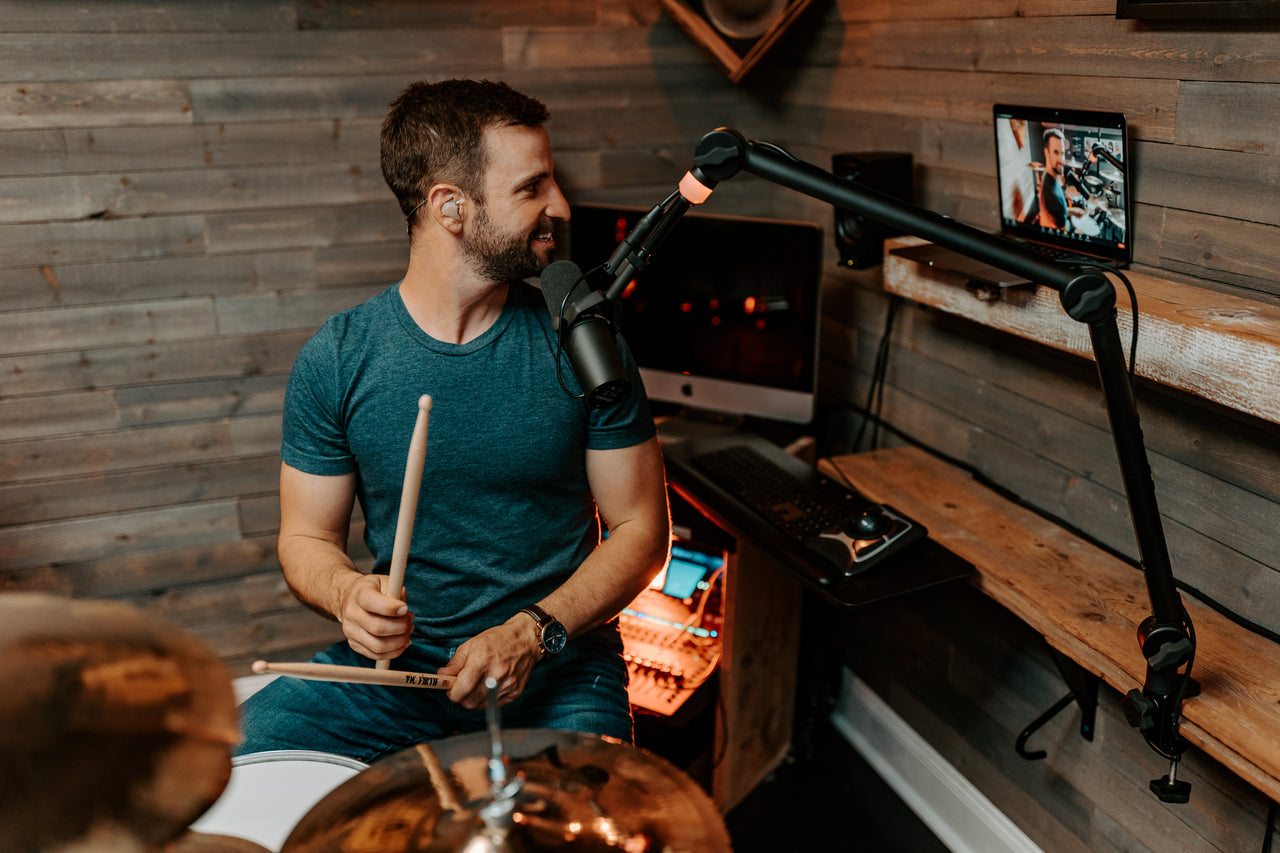



Valerie Franco is a drummer who works with the biggest names in pop. Here’s our interview with Valerie on her path to drumming, what changes when you play from behind the kit, and why in-ear monitoring made her a better performer.
As a session player and former podcast host of Behind the Beat, Valerie Franco brings her rhythmic prowess to every project she touches.
Before studying at the Los Angeles College of Music, Valerie spent her childhood falling in love with the same rock ‘n’ roll heavy-hitters her father adored — particularly Rush.
Since starting her professional career, Valerie has recorded and performed with some of pop’s biggest artists, including Halsey, Kacy Hill, Redfoo, Franky Perez & The Truth, Kylie Minogue, and American Idol winner Allison Iraheta, who recruited Valerie to play for her group Halo Circus in 2012. In 2015, Valerie began earning album credits on releases in the pop music realm, including Bonnie McKee’s punchy EP Bombastic and Megan Tibbits’ album Until I Fly.
She’s landed a few TV spotlights, including a week-long spot on The Late Show with Seth Meyers standing in for Fred Armisen. She has toured extensively with Hayley Kiyoko, who performed alongside Valerie on an MTV Unplugged at Home session to showcase “Gravel to Tempo” and “Sleepover.”
We talked with Valerie about her perspective as a drummer and how she became a lifelong music aficionado.
Early days behind the kit
What are your first memories of playing music?
My very first memories of playing music were with my dad, who isn’t a musician. He taught me how to air drum, because his favorite band was Rush. Literally, we have home movies of me, air drumming on his shoulder, stink-face, playing to Rush.
He took me to my first Rush show when I was 10 years old, and I thought, “This is it.” I took that same energy home to set up buckets on my desk and play them with pencils. My parents walked in on me playing buckets with pencils, and it was over. They said, “Oh, we have a drummer.” They got me lessons, and then I started playing immediately.

Looking back on the whole journey, what made you stick with it?
When you’re meant to do something, you know it when you see it. That’s it. That’s who I am. I see myself in Neil Peart; I see myself in this man, behind two other legends. It was a magnet. Once I saw it, it was over. It was just meant to be.
Did playing the drums come naturally to you?
One hundred percent, and that isn’t a brag at all. I think it came naturally. It was like missing an arm, and then finding it.
Talk to me about the energy at that first Rush show.
It’s nerd rock, so everybody just got really nerdy with it. I’m in love with the Rush fandom in general, and my dad is that same character. He’s that nerdy dude who’s into progressive math rock — I just took it from him. I remember being so floored that anybody didn’t know who Rush was. How could you not know about the feeling of being in this crowd? It’s everything.
We were in the nosebleeds, so he sweet-talked the security guard to let me up front. I was just a 10-year-old cutie pie. I remember gawking at Neil at the front barricade. Even though I wasn’t on stage I could feel the energy, and I wanted all that energy aimed at me too.
When was the first time you felt that energy from a crowd yourself?
Oh boy, it’s all a blur. I sort of black out on stage sometimes. It’s everything I could ever possibly dream of, but it’s like sensory overload from the applause, cheers and whatever else. It’s insane joy, immense pride and a spiritual experience. It’s a whole bunch of energy directed at you like a Ryu Hadouken. It’s hard to explain.
Behind the kit on stage
What’s unique about your vantage point behind the kit at a show?
It’s unique being the artillery in the back, holding it down. I have an eagle-eye perspective when I’m perched in the background, so it’s a cool vantage point. It’s so cool because you get to see the show happening, the audience and everything that’s going on. I don’t think I’ve ever been front and center. I’ve always been perched somewhere, so I get to see the whole show. I get the best of both worlds.
How does that vantage point change how you interact with your bandmates?
It creates those moments on stage where we’re like, “Oh, this part of the song, you hop on the riser, and then we high five or whatever.” One of my favorite pictures that I have is of an artist I play for — Hayley Kiyoko. We’re at Lollapalooza, and there’s a part of the song where I get to stand up and play. She hopped on my riser, and we shared a moment. Some brilliant photographer, Zoe Rain, captured the photo of us looking out into Lollapalooza from behind. It’s making me misty even talking about it, because that was such a wonderful moment.
On in-ear monitoring
What’s the value of in-ear monitoring on stage?
As a drummer I have to be dead-locked to the tracks in order for everything to move forward. It’s impossible to do it without any errors. Getting the right in-ear mix changes the way I play and makes me a better performer. When I hear something I like, I play better.
How does the monitor mix affect how you play?
I mean, it’s a combination, right? It takes a village. You have a great in-ear monitor engineer who can communicate those things, and you have the tools of great in-ear monitors. Again, if you hear something you like, you play the things you like. If it sounds bad, you’ll play bad or you’ll think you’re a bad player. I’ve gone out so many times and had a poor mix.
Prior to Ultimate Ears, I felt like I was a bad player. It affects everything. It would be like if you took a picture and it came back a blur. You think, “I must suck at this.” If I’m hearing something I don’t like, I think “Oh, do I suck?” That’s a really good example.
When did you realize you needed in-ear monitors for hearing protection?
I’ve been in the game for a minute. I did a show at Viper Room. It was kind of an old school camp. We were doing ‘60s and ‘70s rock songs. I was in the back corner of the Viper Room with no in-ear monitors. The stage monitor was literally just a wedge that was blaring. I had like the beginnings of tinnitus afterwards, which if you don’t know what that is, it’s the ringing sound you hear after a loud show. It was in my head, but it wouldn’t go away. Ever since that day I’ve been like, “There’s no way I’m traveling without in-ear monitors.” The thought of living life with a tiny little alien screaming in my head is like not okay. So, in-ear monitors for the win all day.
Drum harder. Hear cleaner.
UE Pro custom in-ear monitors are built for working drummers — fast-paced sets, long tours, and the kind of stage volumes that help drive Valerie’s tinnitus story. The drummer’s default custom in the UE Pro lineup is UE 11 Pro, tuned for fuller low-end character that holds up under heavy kick and bass. Explore the full UE Pro custom in-ear monitor lineup to find the right fit.
Frequently asked questions
Who is Valerie Franco?
Valerie Franco is a Los Angeles-based session drummer and former podcast host of Behind the Beat. She has recorded and performed with artists including Halsey, Hayley Kiyoko, Kylie Minogue, Bonnie McKee, and Allison Iraheta, and made television appearances including a week-long spot on The Late Show with Seth Meyers.
Why do drummers wear in-ear monitors?
In-ear monitors give drummers a consistent personal mix night after night, lock to click and backing tracks more reliably than stage wedges, and isolate from the high stage volume drummers usually sit inside. The seal of a custom in-ear monitor also helps drummers protect their hearing on loud stages over long careers.
Which UE Pro in-ear monitors are best for drummers?
UE 11 Pro is the drummer’s default custom in the UE Pro lineup, tuned for fuller low-end character that holds up under heavy kick and bass. UE 6+ Pro is an entry-level custom for drummers who want enhanced low end at a lower price point. UE 18+ Pro suits the experienced drummer who already gets enough low end from their kit and wants extra headroom and detail.
How can in-ear monitors help musicians protect their hearing?
Custom in-ear monitors create a seal in the ear that isolates the performer from high stage volume. With a consistent personal mix in their ears, musicians don’t need stage wedges turned up to compete with the rest of the stage — which lowers overall stage volume and helps them protect their hearing across a long career. For more on the topic, see Hearing Protection for Touring Musicians.